"Collagen peptides support skin hydration in clinical trials."
RCT evidence exists — though effect sizes are modest and trials short. The claim is directionally accurate when scoped to hydration, not anti-aging broadly.
rel="sponsored nofollow". We earn a commission at no cost to you. Affiliate relationships never change our editorial verdicts. Full disclosure policy
Your feed is full of peptide claims this week. We read the research so you don't post something you can't back up. Verified, overhyped, and needs-context — stamped.

"Collagen peptides support skin hydration in clinical trials."
RCT evidence exists — though effect sizes are modest and trials short. The claim is directionally accurate when scoped to hydration, not anti-aging broadly.
"BPC-157 heals injuries 3x faster than rest alone."
All evidence is animal-model. No human RCTs. "3x faster" has no cited source. BPC-157 is not approved for human use by FDA or EMA.
"GHK-Cu stimulates collagen synthesis in skin."
In-vitro and some small human studies do show collagen-related activity. But topical absorption, concentration, and long-term effects remain under-studied.
"Tirzepatide peptide supplements replicate GLP-1 results."
Tirzepatide is a prescription-only drug. OTC "peptide supplements" claiming to replicate its mechanism are not the same compound or class.
"Peptides are safer than synthetic hormones."
"Peptide" is a structural descriptor, not a safety category. Safety depends on the specific compound, source purity, route of use, and regulatory status — not the word itself.
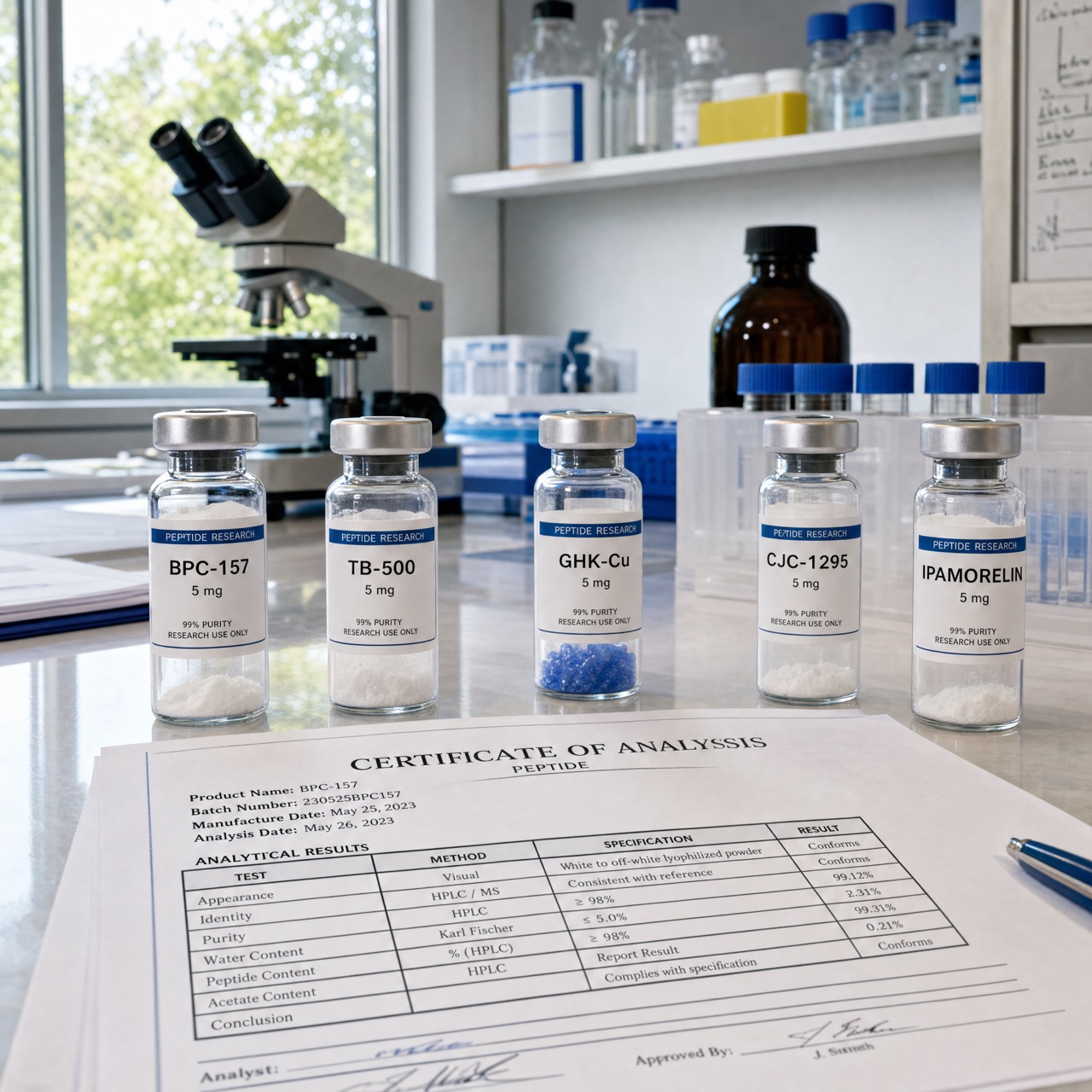
"Third-party tested" on a COA means independent lab analysis was performed.
When the certificate names the lab and method. If the lab is unnamed or the COA shows no batch ID, "third-party tested" becomes a marketing phrase, not a fact.
We check the claims so your audience can trust the content. Evidence-first, creator-written, hype-free.
"BPC-157 repairs tendons faster than any natural recovery protocol."
Animal-model data only. No peer-reviewed human RCT. Not FDA-approved for human use.
"Epithalon activates telomerase and slows cellular aging."
Early cell-biology and animal research is real. Human evidence is sparse. Regulatory status: not approved for human use.
"Collagen peptide supplements visibly reduce wrinkles in 4 weeks."
Some RCTs show improvement in hydration and elasticity. "Visibly reduce wrinkles in 4 weeks" is an outcome claim that most studies don't specifically replicate.
"DSIP (Delta Sleep-Inducing Peptide) puts you into deep sleep naturally."
Mechanism is real in animal studies. Human translation is inconsistent. Oral bioavailability of DSIP is poor — most supplemental forms are unlikely to cross the blood-brain barrier intact.
"Pharmaceutical-grade peptides from our lab — batch tested."
"Pharmaceutical-grade" is a regulated term for FDA-approved drug manufacturing. Research peptide vendors cannot legally make this claim. "Batch tested" without a named lab is unverifiable.
"Semaglutide peptide powder gives the same results as the injections."
Semaglutide (Ozempic/Wegovy) is a prescription drug. Oral bioavailability of unmodified semaglutide peptide is negligible. Compounded versions are a separate, regulated category. This is not the same compound.
Every peptide vendor uses the same two words. But what does "research compound" actually mean legally — and what does it protect you from?
 Regulatory labels vary by compound, jurisdiction, and whether human-use claims appear anywhere on the site or product.
Walk through any peptide vendor site right now and you'll hit the phrase within three clicks: "for research purposes only." It's in the header, on the checkout page, sometimes in the favicon alt text. But it's worth asking what that disclaimer is — and what it isn't.
"Research compound" is not a legal safe harbor. It's a category acknowledgment. The FDA's position on substances like BPC-157, CJC-1295, or Selank is that they are unapproved drug substances. Placing "research only" on the label doesn't change that classification. It signals that the vendor isn't explicitly marketing them for human use — but it doesn't insulate a buyer who uses them that way, and it doesn't guarantee the compound is what the label says.
"Research only" isn't a regulatory exemption. It's a marketing phrase. The COA is the actual evidence — and most vendors won't show you a real one.
What actually matters, from a safety standpoint, is documentation: specifically, whether the vendor can produce a per-lot, third-party certificate of analysis from a named, accredited lab. That document tells you what's in the vial. The disclaimer doesn't. And the phrase "pharmaceutical-grade" — which is everywhere — refers to a manufacturing standard set by FDA drug approval processes. Research peptide vendors do not qualify for that designation.
For creators: if you're recommending a vendor to your audience, the COA is the minimum bar. If they can't produce one with a batch number and a named testing lab, you're endorsing a claim you can't verify. That's not an editorial opinion — it's a documentation gap your audience will eventually notice.
The vendors worth watching are the ones who've structured their documentation so you can match a vial to a test date to a lab report. They exist. They're just not the majority. Our vendor red-flag checklist below covers what to look for before any endorsement.

If a vendor shows you a certificate without all four of these, you're looking at a document, not evidence. Here's what each section tells you — and why the absence of any one flags the whole COA.
This ties the certificate to a physical production run. Without it, the COA is generic — it might describe the compound in theory, not your specific vial.
The lab must be named and independently accredited (ISO 17025 or equivalent). "Tested by our in-house lab" is not third-party testing.
HPLC, mass spectrometry, or equivalent — listed by name. A result without a method cannot be independently replicated or challenged. It's a number without a source.
What did they test for, and what percentage passed? A COA reporting "99% purity" should specify the assay method and the reference standard used to reach that figure.
This is a regulated term. Research peptide vendors selling unapproved compounds cannot legally apply it. When you see it, ask for the documentation — there won't be any.
A certificate without a named, accredited lab is a formatted PDF, not evidence. Batch numbers and test methods are the minimum a real COA includes. One missing = walk away.
Pairing a regulatory disclaimer with dosing guides, cycle lengths, or injection tutorials is not "research use." It signals a vendor marketing for human use behind a disclaimer shield.
Any before/after imagery, user testimonial citing weight loss, muscle gain, or health outcomes on an unapproved research compound page constitutes a drug claim under FDA guidelines.
Transparency in operations predicts transparency in product. A vendor who won't disclose a real business address and has no clear return terms is a vendor who isn't accountable for what ships.
Content claiming a peptide "treats," "cures," "heals," or "prevents" any condition — even in an editorial format — constitutes an uncleared disease claim when tied to a product sold on site.
These are the documentation and language signals we look for before recommending any vendor to creators or their audiences.
Creator turned editor. Seven years in wellness content, five hype cycles survived. Runs the weekly claim audit and vendor watch.

Pharmacist. Reviews all verdicts for regulatory accuracy and flags any claim that crosses from evidence into promotion. Every verdict clears his desk.

Physician with a background in clinical research methodology. Advises on human trial quality and helps the team distinguish animal data from human evidence.

Biochemistry background. Pulls and logs primary sources for every verdict, screenshots vendor claims for the record, and maintains the COA archive.